Qatar Health Card 2026 – Apply, Renew, Check Expiry & Benefits Guide
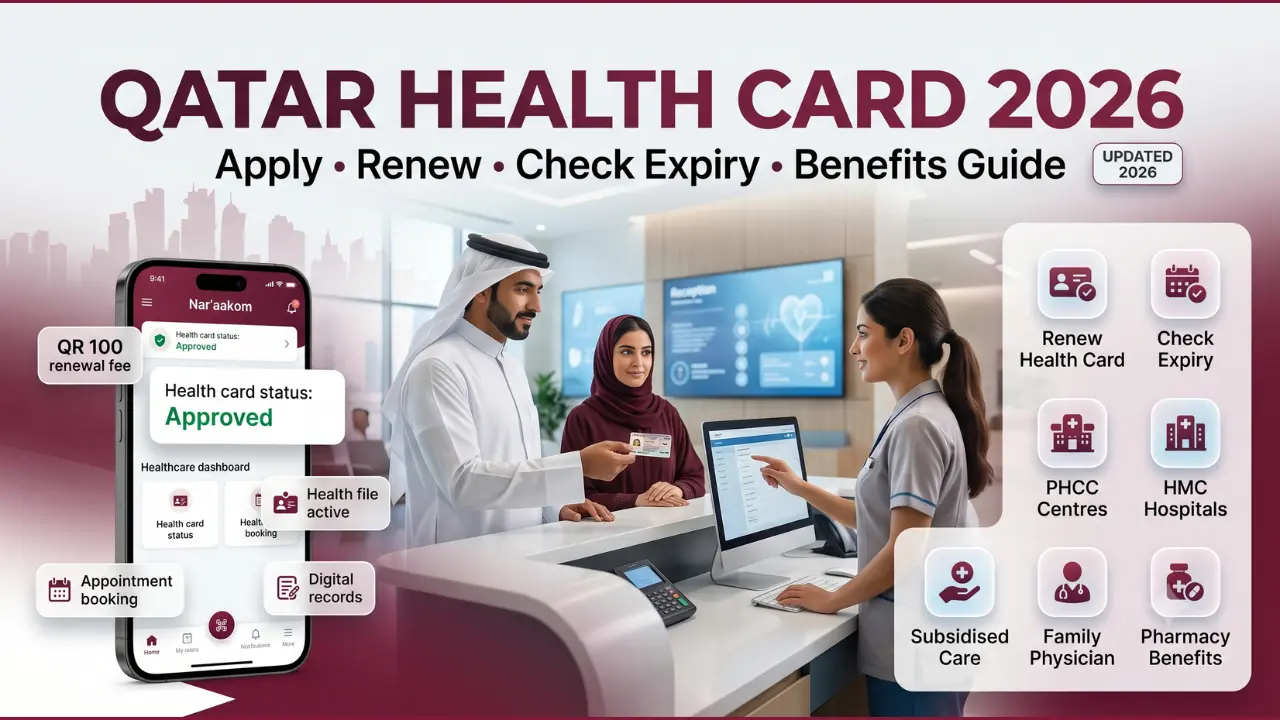
Quick Answer: The Qatar Health Card gives residents and citizens access to subsidised healthcare at all Hamad Medical Corporation (HMC) hospitals and Primary Health Care Corporation (PHCC) centres. As of April 2026, physical health cards are no longer printed — you now present your Qatar ID (QID) at healthcare facilities instead. The registration and annual renewal fees still apply: QR 100 for adult residents (expats), QR 50 for Qatari nationals, GCC residents and domestic staff. You can apply through the Nar’aakom app or renew online through the Hukoomi portal.
Important 2026 Update: Physical Health Card Discontinued
On 17 April 2026, the Ministry of Public Health (MOPH) issued Circular No. (10) of 2026, signed by HE Mansoor bin Ebrahim Al Mahmoud, Minister of Public Health. The circular made two major changes:
- Physical health cards are no longer printed for residents. Instead, you present your Qatar ID (QID) at any public healthcare facility, and the system electronically verifies your health file number.
- Fees have not changed. You still pay the registration fee when you first apply, and the annual renewal fee to keep your health record active.
This update builds on the September 2025 decision that already replaced health cards with QIDs for Qatari citizens. The goal is to simplify procedures, unify official documents, and improve the patient experience at MOPH, PHCC, and HMC facilities.
What this means for you:
- You do not need to carry a separate plastic health card anymore.
- Your QID is now enough to access subsidised services at PHCC and HMC.
- You must still register for a health file (first-time applicants) and renew it every year — even though no card is printed.
- Your existing physical card is still valid until expiry; no need to surrender it.
What Is the Qatar Health Card?
The Qatar Health Card is an official health registration issued by the Ministry of Public Health (MOPH). It links your QID to a health file number in the government healthcare system.
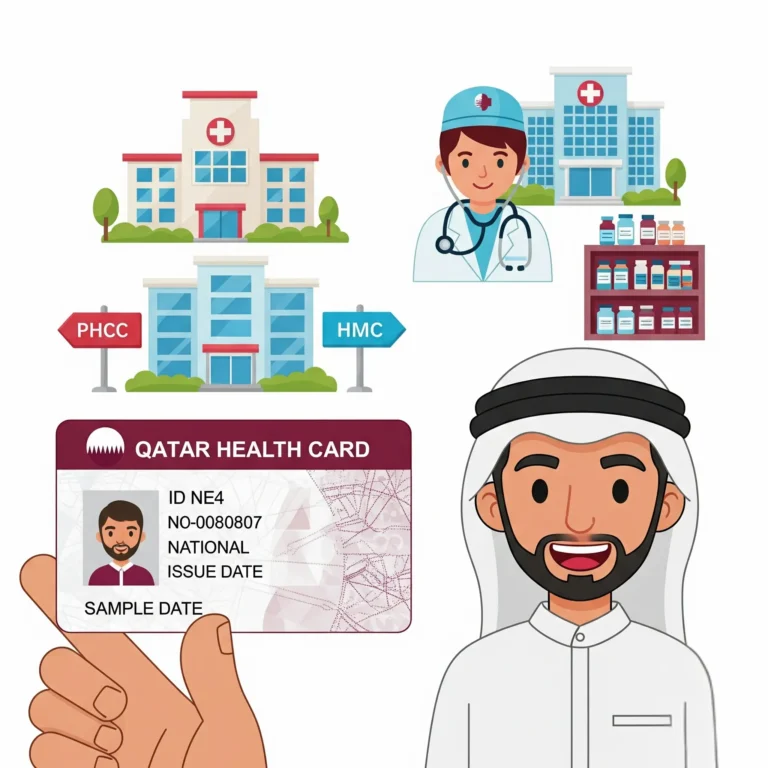
With a valid health card (or health file), you can use any PHCC health centre or HMC hospital across Qatar at subsidised rates — consultations, prescriptions, lab tests, X-rays, emergency care, and ongoing treatment all cost a fraction of the private rate.
Without an active health card registration, you pay full non-subsidised prices at public facilities. For a family of four, the difference can run into thousands of Qatari Riyals a year, which is why anyone living in Qatar long-term should keep their health registration active.
Purpose and Benefits
Holding a valid Qatar Health Card gives you:
- Access to all 31+ PHCC health centres for primary care
- Access to HMC hospitals (Hamad General, Women’s Wellness, Rumailah, Al Wakra, Al Khor, The Cuban, Heart Hospital, and more)
- Subsidised pharmacy rates at government pharmacies
- Assigned family physician and continuity of care
- Digital health record accessible across all public providers
- Reduced emergency department fees
- Home medication delivery (available via PHCC Nar’aakom app)
Who Issues the Qatar Health Card?
The MOPH is the regulatory authority, while Primary Health Care Corporation (PHCC) handles the registration and administration. HMC hospitals accept the registration for specialist and inpatient care, but PHCC is where you apply, renew, and manage your file.
PHCC operates the Nar’aakom mobile application, which now handles the bulk of digital services. Applications submitted through Nar’aakom link directly to the MOPH central system and assign you to a local health centre and a family physician.
Who Needs a Qatar Health Card in 2026?
Almost everyone living in Qatar needs to be registered in the health system — but eligibility rules and fees differ depending on your status.
Expats and Long-Term Residents
If you hold a valid QID, you must register for a health file. This applies to sponsored employees, family-sponsored dependents, students, and anyone with legal residency. The registration fee is QR 100 per year for adults and children.
Qatari Citizens
Since September 2025, Qatari nationals no longer need a separate health card — their QID alone gives them full access to public healthcare. A registration fee of QR 50 still applies in some cases per the PHCC fee structure, though citizens receive the broadest access.
GCC Residents
GCC nationals holding a valid QID pay QR 50 for registration. You’ll need your GCC passport and proof of residence alongside your QID.
Domestic Workers
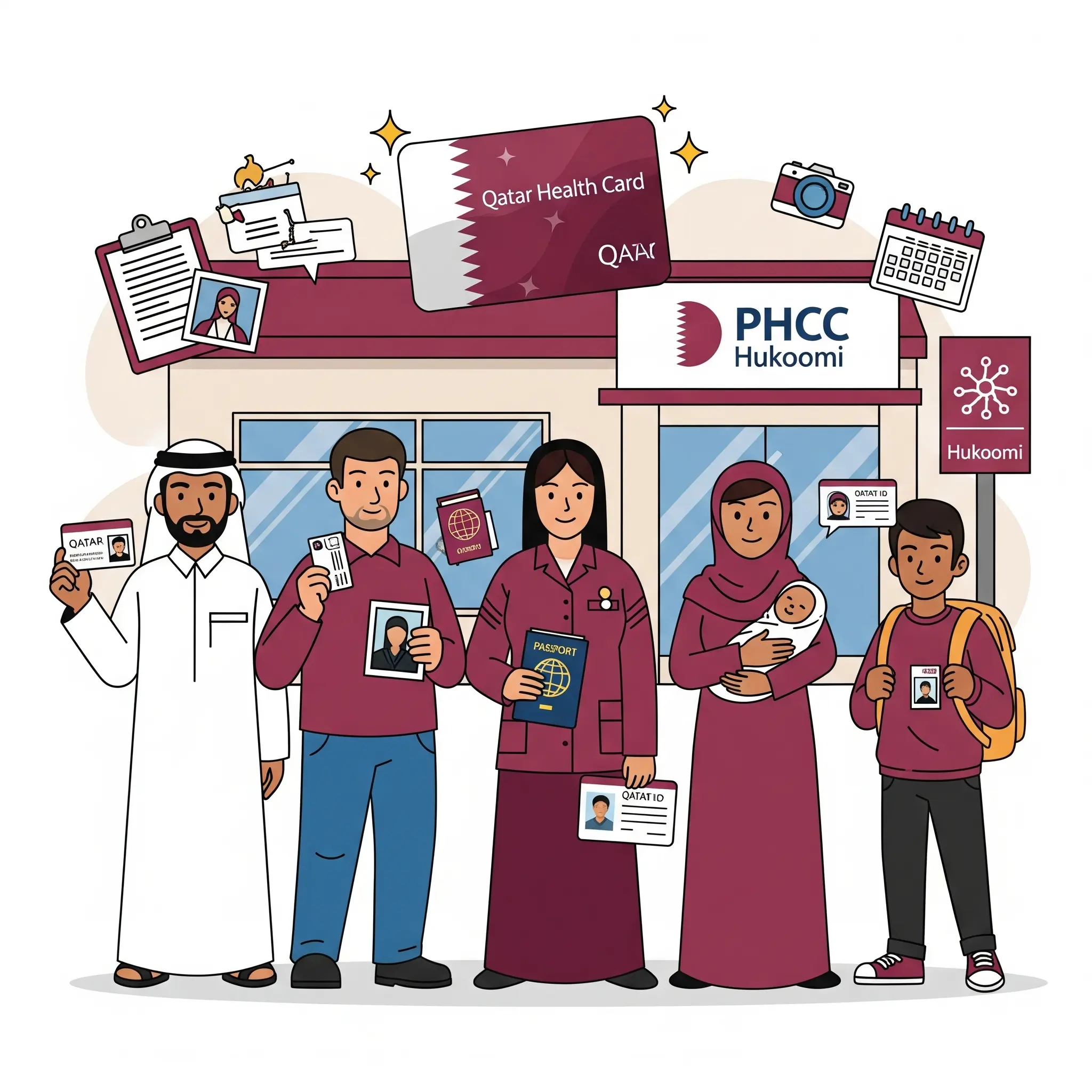
Maids, drivers, cooks, and other personally sponsored domestic staff pay a reduced QR 50 fee. The sponsor (employer) typically submits the application on the worker’s behalf using the sponsor’s QID as proof.
Children and Dependents
Children living in Qatar are eligible and should be registered as soon as they receive their QID (or at birth for children born in Qatar). Dependents under 18 can be added to a parent’s Nar’aakom account.
Qatar Health Card Fees 2026
Here is the current official fee structure per PHCC:
| Applicant Category | Registration / Renewal Fee |
|---|---|
| Adult Resident (expat) | QR 100 |
| Child Resident (expat) | QR 100 |
| Qatari Adult | QR 50 |
| Qatari Child | QR 50 |
| GCC Adult Resident | QR 50 |
| GCC Child Resident | QR 50 |
| Domestic Staff | QR 50 |
Payment method: Credit or debit card only. Cash is not accepted at PHCC or HMC cashiers. Major Visa, Mastercard, and QPAY cards work. Apple Pay and Google Pay are accepted at most HMC facilities.
Lost or damaged card replacement (still applicable for cards issued before the April 2026 change):
| Status | Valid Card | Expired Card |
|---|---|---|
| Qatari Nationals | QR 50 | QR 100 |
| Non-Qataris | QR 100 | QR 200 |
Fees are set by MOPH and may be revised. Always confirm the current rate inside the Nar’aakom app or on the Hukoomi portal before paying.
Documents Required to Apply
Keep these ready before you start your application — missing documents are the single most common reason applications get rejected.
| Document | Notes |
|---|---|
| Valid QID | Must not be expired. If recently renewed, keep the payment receipt handy. |
| Passport-sized photograph | 4 cm × 3 cm, white background, recent. Digital copy for online, printed for in-person. |
| Credit or debit card | For paying the fee online or at the PHCC cashier. |
| Utility bill (KAHRAMAA) | Water or electricity bill showing your name and Qatar address. |
| Rental contract | Accepted as an alternative to a utility bill. |
| Birth certificate | For children being added as dependents (first-time applications). |
| Inoculation card | For children born in Qatar applying for the first time. |
| Sponsor’s QID | For domestic workers — sponsor submits the application. |
If any document is in a language other than Arabic or English, an attested translation may be requested by PHCC staff.
How to Apply for a Qatar Health Card
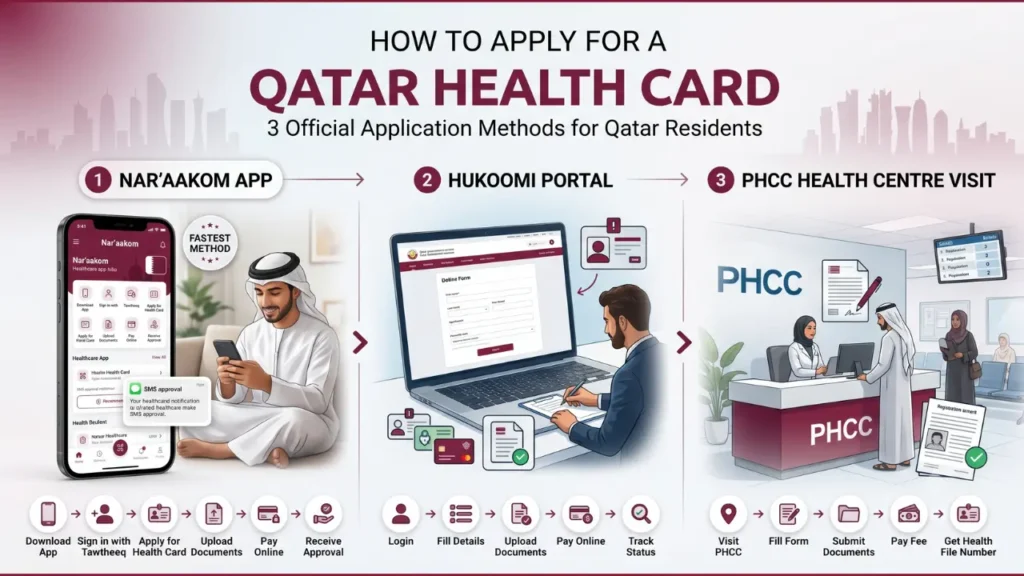
You have three official ways to apply. The Nar’aakom app is the fastest and what PHCC now recommends for most users.
Method 1: Apply Through the Nar’aakom App (Recommended)
Nar’aakom is the official PHCC mobile app for all health services, including new card applications, renewals, appointment booking, and family physician assignment.
- Download the app — search “Nar’aakom” on the Google Play Store or Apple App Store.
- Sign in with Tawtheeq — the National Authentication System (NAS). Use your QID number and NAS password, or a Qatar eID.
- Select “Apply for Health Card” from the e-Services menu.
- Fill in your details — most fields auto-fill from your QID profile. Confirm your address, phone number, and email.
- Upload documents — passport-sized photo, and any supporting documents prompted by the app.
- Pay the fee by credit or debit card inside the app.
- Wait for confirmation — you’ll receive an SMS and in-app notification. Most applications are approved within 24 hours.
Once approved, your health file is active in the MOPH system. From April 2026 onwards, no physical card is mailed — your QID at the hospital reception is enough.
Tip: If you don’t have a Tawtheeq/NAS account, you can register at nas.gov.qa. The one-time setup takes about 10 minutes.
Method 2: Apply Through the Hukoomi Portal
The Qatar government e-services portal also offers health card registration and renewal.
- Visit the Hukoomi health card renewal service.
- Click Login and sign in with your NAS credentials.
- Select Register New Health Card or Renew Health Card.
- Enter your QID and confirm pre-filled details.
- Upload your photo and any supporting documents.
- Pay online by credit or debit card.
- Check your application status through the View Health Card Application Status service.
Method 3: Apply in Person at a PHCC Health Centre
If you prefer face-to-face help or you’re applying for a dependent without a QID-linked profile, walk into your nearest PHCC health centre during morning working hours.
- Visit the PHCC centre assigned to your area (find it on the PHCC All Health Centers page).
- Ask the registration desk for the health card application form.
- Fill in your details and attach your documents.
- Pay the fee at the cashier — credit or debit card only.
- You’ll be issued a PHCC health file number on the spot.
Important: Health card applications at PHCC are only processed during morning working hours. Some busy centres like Al Mamoura, West Bay, and Umm Salal get long queues by 9:00 AM — arrive at opening for the shortest wait.
How to Renew Your Qatar Health Card
Renewing your health card is an annual requirement. Even after the physical card phase-out, the registration itself must be kept active to continue receiving subsidised care.
The quickest way is through the Hukoomi portal:
- Go to the Hukoomi Renew Health Card service.
- Enter your QID and confirm your health file number.
- Select the number of years to renew (most choose 1 or 2).
- Pay the renewal fee (QR 100 for expats, QR 50 for Qataris/GCC/domestic).
- Save the receipt — your renewal is typically instant.
For a full walkthrough with screenshots and troubleshooting, see our complete Qatar Health Card Renewal Guide.
Real-world tip: Renewals through Hukoomi are instant in 99% of cases. If your digital status still shows expired 24 hours later, log into Nar’aakom and refresh — sometimes the sync takes a few hours, particularly if you renewed outside business hours.
How to Check Your Qatar Health Card Expiry
You can check your health card expiry in under a minute:
- In Nar’aakom app: the home screen shows your health card number, expiry date, assigned health centre, and family physician.
- On Hukoomi: the Renew Health Card section shows your current expiry when you enter your QID.
For a detailed step-by-step with screenshots, see our Qatar Health Card Expiry Check guide.
Lost or Damaged Health Card
For cards issued before April 2026 that are lost or damaged, a replacement fee applies. Apply through Nar’aakom or visit any PHCC health centre with your QID.
For new applicants after April 2026, this no longer applies — since no physical card is printed, there’s nothing to lose. Just carry your QID.
Using Your Health Card at Hospitals and Clinics
When you visit a PHCC centre or HMC hospital:
- Present your QID at the reception desk.
- The staff scan your QID and pull up your active health file on the system.
- You’re directed to triage or your assigned clinic.
- Consultations, lab tests, and pharmacy items are charged at subsidised rates.
- Prescriptions are filled at the government pharmacy — most common medicines cost QR 7–25.
| Service | With Active Health File | Without |
|---|---|---|
| GP Consultation | QR 10–30 | Full private rate |
| Specialist Consultation | QR 50–100 | QR 400+ |
| Pharmacy (common meds) | QR 7–25 | Full retail |
| Basic Lab Tests | Subsidised | Full price |
| Emergency Department | Subsidised | Full price |
Registering with a Family Physician
PHCC assigns you a family physician based on the health centre nearest your registered address. Your family physician is your first point of contact for most health concerns — they manage referrals, chronic conditions, vaccinations, and annual check-ups.
To change your physician or health centre, request it inside the Nar’aakom app under “E-Services → Change Family Physician” or “Change Health Centre”. Approvals depend on physician capacity in your preferred centre.
Common Problems and How to Fix Them
“Application Rejected” message
Most rejections are caused by one of three things: expired QID, wrong photo size (must be exactly 4 × 3 cm), or an unreadable utility bill. Re-upload corrected documents and resubmit — you don’t need to pay again.
“QID already linked to a health file”
This usually means you already have an active file from a previous application. Check Nar’aakom before applying again; you may only need to renew.
Nar’aakom app crashes or won’t load after update
Close the app fully, clear cache in your phone settings, and reopen. If the login loop continues, log out, reinstall, and sign back in with Tawtheeq — this resolves 9 out of 10 sync issues.
Personal details need updating
Visit your PHCC centre with your QID and any supporting documents (marriage certificate for a name change, new KAHRAMAA bill for a new address). Updates typically take effect within 2 working days
Wrong health centre assigned
Submit a transfer request through Nar’aakom (“Change Health Centre”). Reasons accepted include address change, sponsor change, and family status change. Transfers usually take 3–5 working days.
Frequently Asked Questions
Final Takeaway
The Qatar Health Card is essential for affordable public healthcare in Qatar — but the way you use it has changed. Since April 2026, your QID replaces the physical card at all PHCC and HMC facilities. You still need to register once and renew every year, and the fees are unchanged.
For most residents, the Nar’aakom app is now the fastest way to apply, renew, check expiry, and manage your family physician. The Hukoomi portal is a good backup for browser-based renewal. In-person visits to PHCC still work but are no longer necessary for most users.
Keep your QID valid, your contact details updated, and your health file renewed every 12 months — that’s all you need to stay covered.
For the latest updates, verify directly on the PHCC Health Card page or the MOPH announcements page.
